
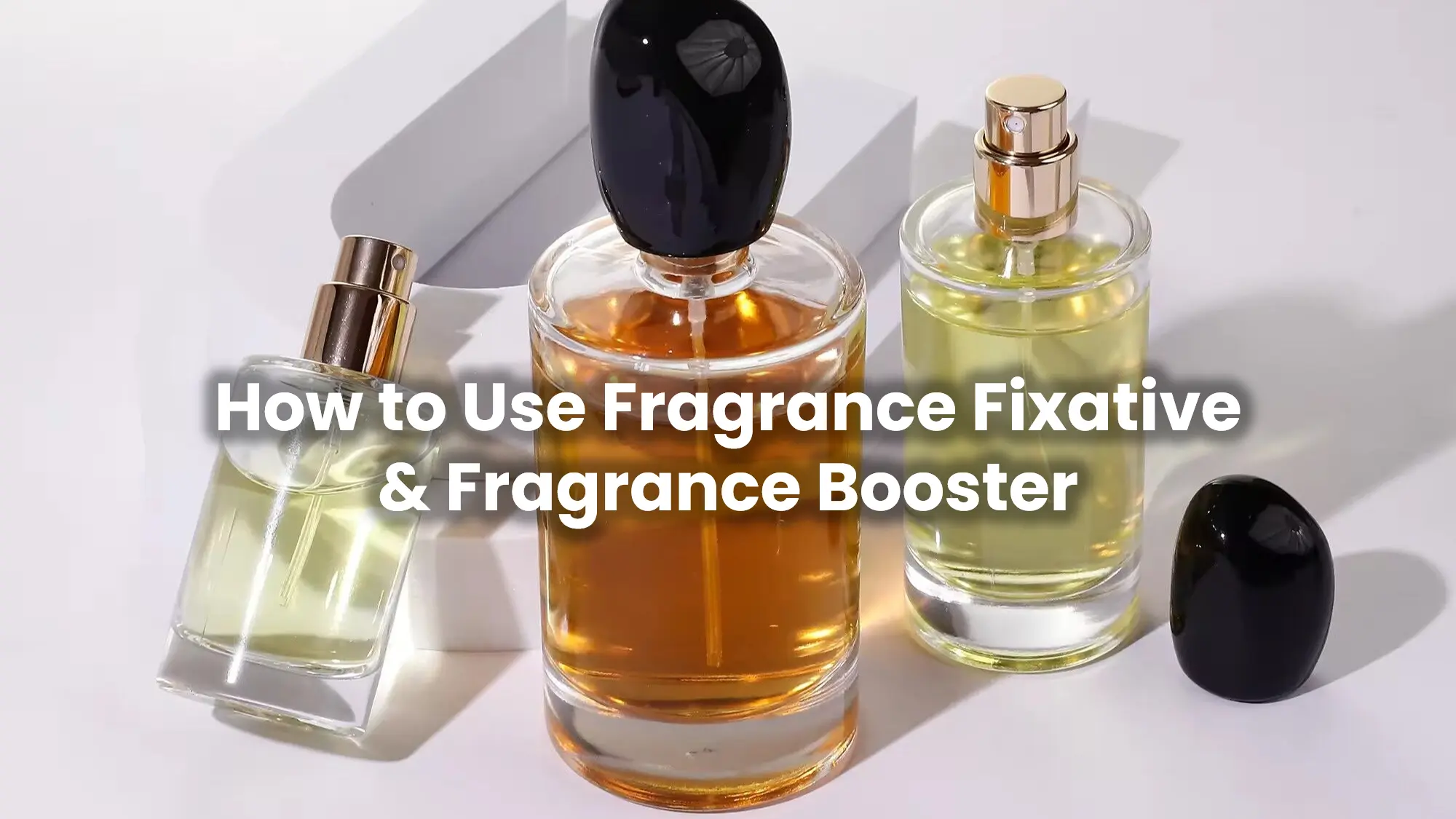
When making perfume, fragrance oil is the main ingredient responsible for the scent. However, the performance of a perfume does not depend only on the fragrance oil. Additional ingredients can be used to improve specific characteristics of the finished perfume.
Two commonly used ingredients are fragrance fixative and fragrance booster. Although both are added to improve perfume performance, they have different functions.
A fragrance fixative is mainly used to help make the perfume last longer, while a fragrance booster is used to help make the perfume smell stronger and more noticeable.
Both products have a common dosage range of 1–3%, but the choice between them depends on what the formulator wants to improve.
What Is a Fragrance Fixative?
A fragrance fixative is an ingredient added to a fragrance formulation to help improve its longevity and staying power.
Fragrance materials have different evaporation rates. Some fragrance components evaporate quickly after application, while others remain for a longer time. A fixative helps support the fragrance system so that the scent can remain noticeable for a longer period.
For example, if a perfume smells good immediately after spraying but the scent becomes weak too quickly, a fragrance fixative may be considered to improve its lasting performance.
The main purpose of a fixative is therefore:
Fragrance Fixative = Helps perfume last longer.
It is particularly useful when the main concern is fragrance longevity rather than fragrance strength.
What Is a Fragrance Booster?
A fragrance booster is an ingredient used to increase the strength and intensity of a perfume's scent.
Some perfume formulations may have a pleasant fragrance but lack enough impact when applied. A fragrance booster can be used to help make the scent more noticeable.
For example, if a perfume lasts reasonably well but the fragrance feels too weak or lacks impact after spraying, a fragrance booster may be considered.
The main purpose of a fragrance booster is:
Fragrance Booster = Helps perfume smell stronger.
This makes it useful when the formulator wants to increase the fragrance intensity without simply increasing the amount of the original fragrance oil.
Fragrance Fixative vs Scent Booster

Although both ingredients are used to improve perfume performance, their main functions are different.
Product | Main Function | When to Consider Using It |
Fragrance Fixative | Helps improve fragrance longevity | Perfume disappears too quickly |
Fragrance Booster | Helps increase fragrance strength | Perfume smells too weak |
Both | Improves longevity and strength | Both performance issues are present |
A simple way to remember the difference is:
Fixative = Lasts Longer
Booster = Smells Stronger
For example, imagine a perfume that smells strong immediately after spraying but becomes weak after a short time. A fixative may be more suitable.
If another perfume lasts for a reasonable period but the scent is not strong enough, a booster may be more suitable.
In some formulations, both can be used when the objective is to improve both fragrance longevity and intensity.
Recommended Dosage: 1–3%
The common dosage range for both fragrance fixative and fragrance booster is 1–3%.
Dosage | General Approach |
1% | Starting point for formulation testing |
2% | Moderate dosage |
3% | Higher dosage within the common range |
The suitable dosage depends on the fragrance formulation and the desired result. It is recommended to conduct small-scale trials before selecting the final dosage.
For a 1 kg finished perfume:
- 1% = 10 g
- 2% = 20 g
- 3% = 30 g
For a 100 g finished perfume:
- 1% = 1 g
- 2% = 2 g
- 3% = 3 g
The remaining ingredients should be adjusted accordingly so that the final formulation remains at 100%.
Example Perfume Formulation with Fragrance Fixative
A simple example using a fragrance fixative is:
Ingredient | Percentage |
Fragrance Oil | 20% |
Fragrance Fixative | 1–3% |
Perfume Ethanol / Suitable Solvent | 77–79% |
Total | 100% |
For a 1 kg batch using 2% fixative:
- Fragrance Oil: 200 g
- Fragrance Fixative: 20 g
- Perfume Ethanol / Suitable Solvent: 780 g
The purpose of this example is to show how the dosage is calculated. The fragrance concentration can be adjusted according to the desired perfume type and formulation.
Example Perfume Formulation with Fragrance Booster
A fragrance booster can be used in a similar way:
Ingredient | Percentage |
Fragrance Oil | 20% |
Fragrance Booster | 1–3% |
Perfume Ethanol / Suitable Solvent | 77–79% |
Total | 100% |
For a 1 kg batch using 2% booster:
- Fragrance Oil: 200 g
- Fragrance Booster: 20 g
- Perfume Ethanol / Suitable Solvent: 780 g
The main difference is not the dosage range, but the performance objective.
A fixative is selected when longer-lasting fragrance is required, while a booster is selected when stronger fragrance intensity is required.
Applications of Fragrance Fixative
Fragrance fixative can be considered for various fragrance products where longer-lasting scent is desired.
Perfume and Eau de Parfum
A fixative can help support the staying power of perfume and Eau de Parfum formulations.
Eau de Toilette
Eau de Toilette generally contains a lower fragrance concentration than many Eau de Parfum products. A fixative may be considered when additional fragrance persistence is required.
Body Mist
Body mist normally has a lighter fragrance concentration. A suitable fixative can be evaluated when longer-lasting fragrance is desired.
Room Spray
A fixative can be considered when the objective is to extend the time the fragrance remains noticeable after spraying.
Car Perfume
Car perfume is another application where fragrance longevity is important. The fixative should be tested together with the fragrance and solvent system.
Linen and Fabric Spray
For fabric applications, longer-lasting fragrance can be an important product feature. The fixative should be tested for compatibility with the complete formulation and intended application.
Applications of Fragrance Booster
Fragrance boosters can be used in fragrance products where stronger scent intensity is desired.
Perfume
A booster can be used when the perfume has a pleasant scent but does not provide enough fragrance impact.
Body Mist
A booster may help improve fragrance intensity in lighter fragrance formulations.
Room Spray
For room sprays, a booster can be considered when a stronger scent is required after spraying.
Car Perfume
A fragrance booster can help increase the perceived strength of the fragrance inside a vehicle.
Linen and Fabric Products
A booster may be considered when the fragrance needs to have greater scent impact on the finished product.
The actual suitability depends on the complete formulation and the characteristics of the fragrance used.
How to Choose Between Fixative and Booster
The easiest way to choose is to first identify the problem with the perfume.
Ask:
"Does the perfume smell strong enough?"
If the answer is no, a Fragrance Booster may be more suitable.
Next ask:
"Does the perfume last long enough?"
If the answer is no, a Fragrance Fixative may be more suitable.
If the answer to both questions is no, the formulation may be evaluated with both a fixative and a booster.
This approach is more useful than simply adding more fragrance oil, since increasing fragrance oil can change the entire fragrance concentration and formulation.
How to Test the Dosage
A simple formulation trial can be prepared using different dosage levels.
For a fixative, prepare:
- Sample A: 1% fixative
- Sample B: 2% fixative
- Sample C: 3% fixative
Evaluate the samples for fragrance longevity.
For a booster, prepare:
- Sample A: 1% booster
- Sample B: 2% booster
- Sample C: 3% booster
Evaluate the samples for fragrance intensity.
Keep other formulation ingredients as consistent as possible. This makes it easier to understand the effect of the fixative or booster.
Testing different levels also helps prevent unnecessary use of the ingredient. The highest dosage does not automatically mean the best result.
Factors That Can Affect Performance
The performance of a fixative or booster can vary depending on the complete fragrance formulation.
Fragrance Oil
Different fragrance oils have different compositions and characteristics. Therefore, a dosage that works well with one fragrance may not produce exactly the same result with another.
Fragrance Concentration
A perfume containing a high fragrance concentration will behave differently from a light body mist.
Solvent System
The solvent can affect fragrance evaporation, diffusion and overall scent performance. The fixative or booster should therefore be evaluated together with the complete formulation.
Product Type
Perfume, room spray, car perfume and fabric spray have different requirements. The formulation should be tested according to its intended application.
Storage and Packaging
Temperature, light, air exposure and packaging can affect fragrance quality over time. Suitable packaging and storage conditions are important for maintaining consistent product performance.
Can Fragrance Fixative and Fragrance Booster Be Used Together?
Yes, they can be considered together when the formulation requires improvement in both areas.
For example, a perfume may have two problems:
- The fragrance is not strong enough.
- The fragrance does not last long enough.
In this situation, a formulator may evaluate a combination of fixative and booster.
However, the total formulation should always be adjusted to maintain 100%. For example, adding 2% fixative and 2% booster means that the remaining ingredients must be adjusted accordingly.
Small-scale testing is recommended before applying the combination to a larger production batch.
Common Mistakes to Avoid
One common mistake is confusing the function of the two products. A fixative and a booster are not intended to solve exactly the same problem.
Another mistake is assuming that increasing the dosage will always produce better performance. Higher dosage can affect the fragrance balance and overall formulation.
It is also important to calculate dosage based on the total finished product weight.
For example, 2% in a 1 kg batch means 20 g, not 20 g added on top of an already completed 1 kg formulation.
Finally, evaluate the finished product after proper mixing and resting. Immediate testing may not represent the final fragrance performance.
Conclusion
Fragrance fixative and fragrance booster are two different formulation ingredients with different purposes.
A fragrance fixative is used mainly to help make perfume last longer, while a fragrance booster is used mainly to help make perfume smell stronger.
Both have a common dosage range of 1–3%. A practical approach is to start with 1%, then compare 2% and 3% during formulation testing to determine the most suitable level.
Choosing the right product starts with identifying the main performance issue. If the perfume disappears too quickly, consider a fixative. If the perfume is not strong enough, consider a booster. When both longevity and strength need improvement, both products can be evaluated as part of the overall fragrance formulation.