
Cosmetic and personal care products often contain a large amount of water. Shampoos, conditioners, body washes, facial cleansers, lotions, creams and many other products are water-based formulations.
Water is important for the texture and performance of these products, but it also creates an environment where microorganisms such as bacteria, yeast and mould can grow. If microbial growth is not controlled, the product may develop an unpleasant smell, change in colour or texture, lose its quality or become unsuitable for use.
This is why preservatives are an important part of many cosmetic formulations.
One preservative that has been used for many years in personal care products is DMDM Hydantoin. It is a formaldehyde-releasing preservative that works by providing a controlled amount of formaldehyde in the formulation. The released formaldehyde helps control the growth of microorganisms and protects the product during storage and use.
DMDM Hydantoin is commonly associated with products such as shampoos, conditioners, hair care products, lotions, creams and other water-containing personal care formulations. Understanding how DMDM Hydantoin works is important for formulators, manufacturers, raw material buyers and anyone involved in the production of cosmetics and personal care products.
What Is DMDM Hydantoin?
DMDM Hydantoin is a synthetic organic compound used mainly as an antimicrobial preservative in cosmetic and personal care formulations.
DMDM Hydantoin belongs to a group of preservatives commonly called formaldehyde releasers or formaldehyde donors.
This name can sound concerning at first. However, the important point is that DMDM Hydantoin is not simply added to a formulation as free formaldehyde. Instead, it can gradually release small amounts of formaldehyde under suitable conditions. The released formaldehyde provides antimicrobial activity that helps protect the finished product.
What Is the Main Function of DMDM Hydantoin?
The main function of DMDM Hydantoin is preservation.
A preservative is added to a cosmetic product to control the growth of microorganisms that may enter the product during manufacturing, storage or normal consumer use.
These microorganisms can include:
- Bacteria
- Yeast
- Mould
- Other fungi
For example, imagine a shampoo containing water, surfactants, conditioning ingredients and botanical extracts.
The formulation contains many ingredients that can support microbial growth. In addition, the bottle may be opened and closed repeatedly in a bathroom environment.
Without adequate preservation, microorganisms may gradually multiply.
DMDM Hydantoin helps reduce this risk by releasing a small amount of formaldehyde that interferes with microorganisms and helps prevent their growth.
This is why preservatives should not be viewed simply as ingredients that "make the product last longer". Their more important function is to protect the formulation from microbial contamination throughout its intended shelf life and use period.
Why Do Cosmetics Need Preservatives?
A common question is:
"If the product is manufactured cleanly, why does it still need a preservative?"
Good manufacturing practices are very important, but they cannot completely eliminate the risk of microbial contamination.
A cosmetic product can be exposed to microorganisms at several stages:
- During manufacturing
- During filling and packaging
- During transportation
- During storage
- When the consumer opens the container
- When the consumer repeatedly uses the product
This does not mean every water-based product automatically requires DMDM Hydantoin. The correct preservative system depends on the complete formulation.
The formulator must consider the water activity, pH, raw materials, packaging, manufacturing process and expected consumer use.
How Does DMDM Hydantoin Work?
DMDM Hydantoin works differently from preservatives that remain completely unchanged in the formulation.
It acts as a formaldehyde-releasing preservative.
In an aqueous formulation, DMDM Hydantoin can release small amounts of formaldehyde. The available formaldehyde provides antimicrobial activity against susceptible microorganisms.
In simple terms:
DMDM Hydantoin → controlled release of formaldehyde → antimicrobial action → protection of the cosmetic product
The amount released is influenced by formulation conditions such as temperature, pH and the overall chemical environment.
This controlled release is the reason DMDM Hydantoin can provide preservation without requiring the formulation to contain a large amount of free formaldehyde.
Formaldehyde-releasing preservatives are designed to maintain a low level of available formaldehyde over time rather than adding a large quantity of free formaldehyde directly to the finished product.
Which Cosmetic Products Can Use DMDM Hydantoin?
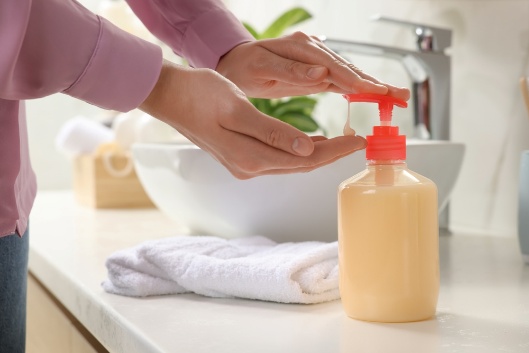
DMDM Hydantoin has historically been used in many types of cosmetic and personal care products.
Examples include:
1. Shampoo
Shampoo is one of the common applications for preservatives because it contains a significant amount of water and is frequently exposed to the bathroom environment.
DMDM Hydantoin can help protect shampoo against microbial growth during its shelf life and repeated consumer use.
2. Hair Conditioner
Conditioners commonly contain water, conditioning agents, oils and other organic materials.
These ingredients can create a formulation where microbial control is important.
DMDM Hydantoin has been reported in hair conditioners and other hair care products.
3. Body Wash and Shower Products
Body washes and liquid cleansing products usually contain high levels of water.
A suitable preservative system helps maintain the product during repeated use.
4. Hand Wash
Liquid hand wash is another example of a water-based product that may require preservation.
However, the preservative system should be selected based on the complete formulation rather than choosing DMDM Hydantoin automatically.
5. Lotions and Creams
Oil-in-water and water-in-oil emulsions can both require microbial protection, particularly when they contain significant amounts of water.
DMDM Hydantoin has historically been used in lotions, creams and other personal care formulations.
6. Hair Styling Products
Some hair gels, hair creams and styling products also require preservation.
DMDM Hydantoin may be considered where its properties are suitable for the formulation.
7. Other Personal Care Products
Depending on the formulation and local regulations, DMDM Hydantoin has also been used in products such as:
- Facial products
- Cleansing products
- Body care products
- Makeup products
- Personal hygiene products
Historical Cosmetic Ingredient Review (CIR) data show DMDM Hydantoin use across a wide range of cosmetic categories.
Why Is DMDM Hydantoin Popular in Formulation?
There are several reasons formulators may consider DMDM Hydantoin.
Broad antimicrobial activity
It can help control different types of microorganisms.
Suitable for water-based formulations
Since it works through the controlled release of formaldehyde, it can be useful in aqueous cosmetic systems.
Easy to incorporate
Depending on the specific raw material grade and supplier instructions, it can generally be incorporated into the water phase or during the later stage of production.
Useful across different personal care categories
Its historical use covers products ranging from shampoos and conditioners to lotions and other cosmetic preparations.
However, these advantages do not mean it is the best preservative for every formulation.
The final choice should always be based on formulation compatibility, regulatory requirements and preservative efficacy testing.
What Is the Typical Usage Level of DMDM Hydantoin?
The correct usage level depends on the raw material specification, formulation, regulatory requirements and required antimicrobial performance.
A commonly discussed formulation range is approximately:
- - 0.6% DMDM Hydantoin
The exact level should not simply be selected from a general range. The formulator should determine the minimum effective concentration through formulation development and preservative efficacy testing.
For example:
DMDM Hydantoin | Example Purpose |
0.1% | Low starting level for formulation evaluation |
0.2% | Common development starting point |
0.3% | Moderate preservation level |
0.5% | Higher level within some regulatory limits |
0.6% | EU maximum concentration |
These figures are formulation examples, not a universal dosage recommendation.
The European Union lists DMDM Hydantoin in Annex V as a permitted cosmetic preservative with a maximum concentration of 0.6% in the ready-to-use preparation.
It is important to distinguish between a supplier's recommended usage range and a country's legal maximum. A product that is suitable at a certain concentration in one market may have different requirements in another market.
Is DMDM Hydantoin Safe in Cosmetics?
This is one of the most common questions about DMDM Hydantoin.
The answer needs to be considered carefully.
DMDM Hydantoin has been evaluated as a cosmetic ingredient by the Cosmetic Ingredient Review Expert Panel. The CIR has reviewed available safety information and concluded that DMDM Hydantoin is safe for use in cosmetics at current levels of use when formulated appropriately.
At the same time, DMDM Hydantoin is a formaldehyde releaser and formaldehyde is a known skin sensitiser. People who are already sensitised to formaldehyde or certain formaldehyde-releasing preservatives may develop allergic contact dermatitis when exposed to sufficiently high levels.
Therefore, "safe" should not be interpreted as "there is no possible reaction in any person".
The more useful way to understand cosmetic safety is:
A cosmetic ingredient must be used at an appropriate concentration and under appropriate conditions, while the finished formulation must meet applicable safety and regulatory requirements.
This is also why regulatory authorities establish maximum permitted concentrations for cosmetic preservatives.
DMDM Hydantoin vs Phenoxyethanol
Both DMDM Hydantoin and phenoxyethanol are used as cosmetic preservatives, but they work differently.
DMDM Hydantoin is a formaldehyde-releasing preservative.
Phenoxyethanol does not work by releasing formaldehyde.
This difference can be important when selecting a preservative system based on consumer expectations, formulation requirements and market positioning.
The two ingredients may also behave differently depending on pH, formulation composition and microorganism challenge.
Therefore, replacing one preservative with another at the same percentage is not necessarily a suitable formulation change.
A reformulation should be followed by appropriate stability and preservative efficacy testing.
How to Add DMDM Hydantoin During Manufacturing
The addition method depends on the specific grade and supplier specification, but DMDM Hydantoin is generally suitable for incorporation during the later stage of cosmetic manufacturing.
A simple example for a water-based formulation is:
Step 1: Prepare the main water phase
Add purified or deionised water to the mixing vessel.
Other water-soluble ingredients can be added according to the formulation.
Step 2: Complete the main mixing process
Add surfactants, humectants, thickeners, conditioning ingredients or other components according to the product type.
Mix until the formulation is uniform.
Step 3: Check the temperature
The temperature should be suitable for the specific DMDM Hydantoin grade.
Adding the preservative during a cooler stage can help reduce unnecessary exposure to high processing temperatures.
Step 4: Add DMDM Hydantoin
Add the required amount slowly while mixing.
Continue mixing until the preservative is evenly distributed throughout the formulation.
Step 5: Adjust pH
Measure the finished formulation and adjust the pH to the target range required by the product.
Step 6: Conduct quality testing
The finished product should be checked for:
- Appearance
- Odour
- pH
- Viscosity
- Stability
- Microbial quality
- Preservative efficacy
The exact production sequence can change depending on whether the product is a shampoo, lotion, cream, conditioner or another formulation.
What Factors Affect DMDM Hydantoin Performance?
Adding DMDM Hydantoin is only one part of preservation.
Several factors can affect the final result.
1. pH
The pH of the formulation can influence preservative behaviour and overall microbial growth.
Different cosmetic products have different target pH values.
For example, a facial product may have a different target pH from a shampoo or body wash.
Therefore, pH should always be considered when developing the preservation system.
2. Water Activity
Microorganisms require available water to grow.
Two products can contain similar amounts of water but have different microbial risks depending on the other ingredients present.
3. Raw Materials
Natural extracts, proteins, botanical ingredients and other raw materials may introduce additional microbial risk.
4. Packaging
A pump bottle can provide a different contamination risk from an open jar.
Products that require consumers to repeatedly place their fingers into the container may have greater exposure to contamination.
5. Manufacturing Hygiene
Good manufacturing practices reduce the initial microbial load.
A preservative should not be used as a replacement for proper manufacturing hygiene.
6. Storage Temperature
Temperature can affect both microbial growth and preservative behaviour.
7. Product Age
The preservative system needs to remain effective throughout the intended shelf life, not just immediately after manufacturing.
What Happens If Too Much DMDM Hydantoin Is Used?
More preservative does not automatically mean better preservation.
Excessive use may create unnecessary formulation and regulatory concerns.
It can also increase exposure to the preservative and, in the case of DMDM Hydantoin, increase the potential amount of formaldehyde released.
For this reason, the practical approach is:
Use the lowest effective level that provides adequate preservation and complies with the applicable regulatory requirements.
This principle is useful for many preservatives, not only DMDM Hydantoin.
DMDM Hydantoin: Common Questions
Is DMDM Hydantoin a preservative?
Yes. Its primary cosmetic function is preservation.
Is DMDM Hydantoin a formaldehyde releaser?
Yes. It can release small amounts of formaldehyde in cosmetic formulations and uses this antimicrobial activity as part of its preservation mechanism.
Can DMDM Hydantoin replace every other preservative?
No. Preservative selection depends on the formulation, microorganisms of concern, pH, packaging and regulatory requirements.
Does adding DMDM Hydantoin guarantee that a product will not spoil?
No. Preservation depends on the complete formulation and manufacturing process. Proper formulation, hygiene, packaging and testing are all important.
Conclusion
DMDM Hydantoin is a well-established preservative used in cosmetics and personal care products, particularly in water-containing formulations such as shampoos, conditioners, body washes, lotions and creams.
Its main function is to control microbial growth through the controlled release of small amounts of formaldehyde. This makes it different from non-formaldehyde-releasing preservatives and explains both its antimicrobial effectiveness and the regulatory attention given to its use.
DMDM Hydantoin can be useful in cosmetic formulation, but selecting the correct concentration requires more than simply following a general dosage range. The formulator needs to consider the product's pH, water content, raw materials, packaging, manufacturing process, target market and expected microbial risk.
Ultimately, successful preservation is about finding the right balance between microbial protection, formulation compatibility, product stability, consumer safety and regulatory compliance.
For manufacturers developing cosmetics or personal care products, DMDM Hydantoin can therefore be considered as part of a broader preservation strategy rather than simply an ingredient added at a fixed percentage.