
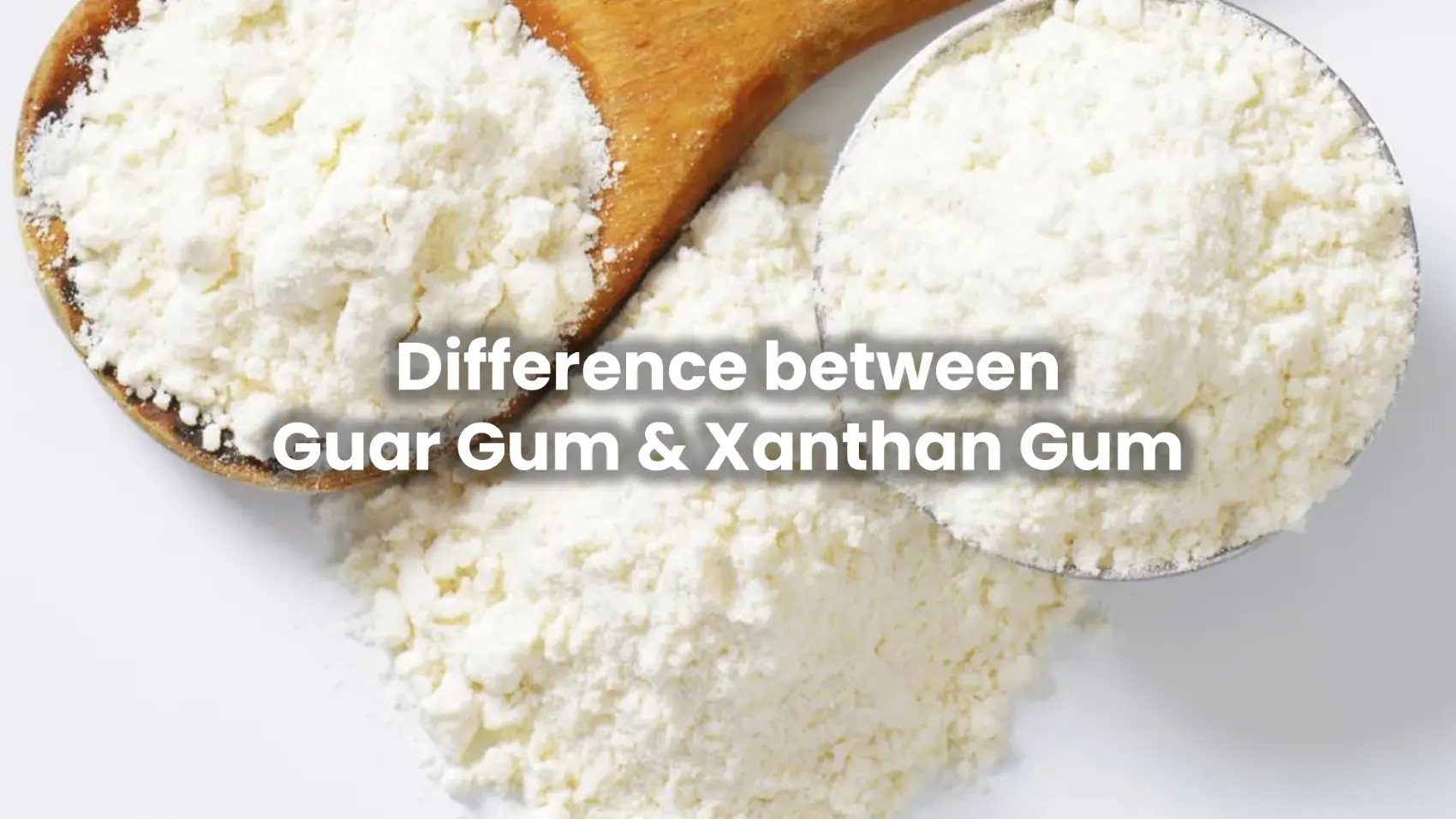
Gums are widely used as thickening, stabilizing, and emulsifying agents in various industries, including food, pharmaceuticals, cosmetics, and industrial applications. Two of the most commonly used gums are Guar Gum and Xanthan Gum. While both serve similar purposes, they have distinct differences in terms of source, chemical composition, functionality, and applications. This article explores these differences in detail.
What is Guar Gum?
Guar gum is a natural polysaccharide derived from the seeds of the guar plant Cyamopsis tetragonoloba. It is composed primarily of galactomannan, a carbohydrate that forms a viscous gel when mixed with water. Guar gum is commonly used as a thickener, stabilizer, and binder in many industries due to its excellent water-holding capacity.
Key Properties of Guar Gum:
- Highly soluble in cold and hot water
- Forms a thick, gel-like solution at low concentrations
- pH stability: Works best in neutral to slightly acidic conditions
- Synergistic with other hydrocolloids, improving viscosity
- Easily affected by salts and acids, reducing its thickening ability
What is Xanthan Gum?
Xanthan gum is a microbial polysaccharide produced by the fermentation of sugars using the bacterium Xanthomonas campestris. It is widely used as a stabilizer and thickener in food, pharmaceuticals, and industrial applications due to its high viscosity and excellent stability under extreme conditions.
Key Properties of Xanthan Gum:
- Highly stable under a wide range of temperatures and pH levels
- Soluble in both hot and cold water
- Provides high viscosity even at low concentrations
- Resistant to enzymatic degradation
- Stable in the presence of salts and acids
Comparison between Guar Gum and Xanthan Gum
Property | Guar Gum | Xanthan Gum |
Source | Guar plant Cyamopsis tetragonoloba | Fermentation by Xanthomonas campestris |
Solubility | Soluble in hot and cold water, but less stable in acidic conditions | Soluble in hot and cold water, highly stable in acidic and alkaline conditions |
Viscosity | Thickens at low concentrations but decreases in acidic or high-salt environments | Maintains viscosity across a broad pH and temperature range |
Texture | Smooth and slightly slimy | Slightly gummy and elastic |
Stability | Sensitive to acid, heat, and salt | Stable in extreme conditions (pH, heat, salt) |
Common Uses | Food, cosmetics, pharmaceuticals, oil drilling | Food, cosmetics, pharmaceuticals, industrial applications |
Industrial Applications
Both gums are widely used in various industries, but their choice depends on the specific needs of the application.
- Food Industry
Guar gum is widely used in food industry such as dairy items due to its superior water retention ability. It enhances texture and improves shelf life. Xanthan gum, on the other hand, is commonly found in dressings and gluten-free products because of its exceptional stability under acidic and high-temperature conditions.
- Pharmaceutical Industry
In the pharmaceutical sector, guar gum serves as a binding and disintegrating agent in tablet formulations, helping in controlled drug release. Xanthan gum is preferred in liquid medications, suspensions, and controlled drug delivery systems due to its ability to maintain viscosity over time.
- Cosmetic Industry
Both gums find extensive use in personal care products. Guar gum is used in shampoos, lotions, and creams for thickening and providing a smooth consistency. Xanthan gum is preferred for skincare formulations like gels, creams, and serums because of its high stability in different pH environments and its ability to suspend active ingredients effectively.
- Oil and Gas Industry
Guar gum plays a crucial role in the oil and gas industry, especially in hydraulic fracturing. It is used as a thickening agent in drilling fluids to help suspend solid particles and carry them to the surface. Its excellent water-absorbing properties make it ideal for this application. Xanthan gum, in contrast, is used in drilling muds where extreme temperature and salinity conditions are present. Its stability under harsh conditions makes it a preferred choice for enhancing fluid viscosity and controlling the rheology of drilling fluids.
- Other Industrial Uses
Guar gum is also used in the paper industry for improving paper strength and in textile printing for enhancing dye penetration. Xanthan gum finds applications in paints and coatings, adhesives, and even the construction industry, where it helps in water retention and improving material stability.
Which One Should You Choose?
 The choice between guar gum and xanthan gum depends on the application:
- If higher viscosity and a smooth texture is needed, guar gum is a better choice.
- If high stability under various conditions is needed, xanthan gum is suggested.
- In food and cosmetics, xanthan gum performs better in acidic conditions, while guar gum is more suitable for neutral pH applications.
- For industrial applications, guar gum is favoured in oil drilling and paper production, while xanthan gum is better suited for paint, adhesives, and construction materials.
Conclusion
Guar gum and xanthan gum are both versatile hydrocolloids with unique properties that make them useful in different industries. Understanding their differences can help manufacturers and formulators select the best ingredient for their specific needs. Whether for what type of industrial applications, the choice of gum should be based on viscosity requirements, stability conditions, and compatibility with other ingredients. Both have their strengths, making them indispensable in modern formulations.